
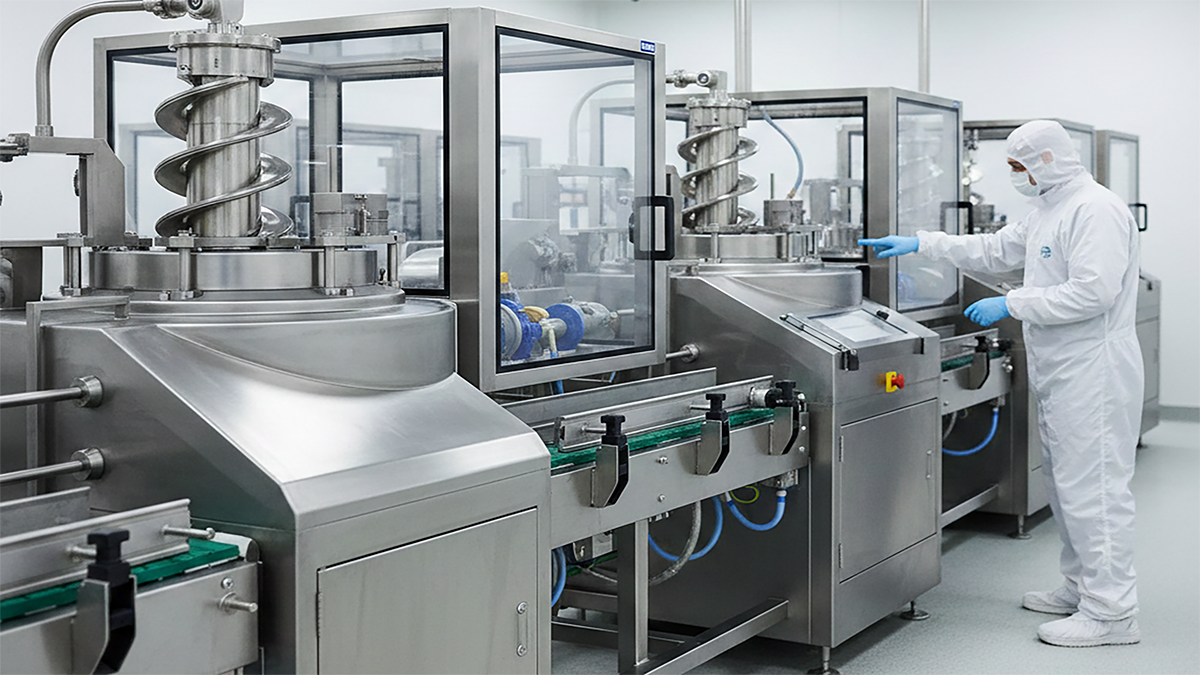
Hygienic design is not only about how equipment looks on day one; it determines how reliably a plant can clean, inspect, and maintain machinery across months and years of operation. In processing environments, design decisions affect microbial control, allergen separation, product safety, cleaning time, water and chemical usage, and the practical ability of technicians to access components without unsafe workarounds.
Serviceability is the operational twin of hygienic design. If a component is cleanable but impossible to access, or accessible but designed with contamination traps, plants face repeated sanitation challenges and higher downtime. A practical approach is to evaluate equipment with a combined “cleanability + serviceability” checklist.
1) Cleanability: Remove Harborage Points and Residue Traps
The first hygiene risk in processing equipment is residue retention. Product build-up can form in dead legs, crevices, sharp internal corners, gasket misalignments, and areas with poor drainage. Plant teams should inspect for:
- Dead ends in piping: avoid stagnant zones where flow does not fully exchange.
- Sharp corners and pockets: prefer smooth transitions with cleanable radii.
- Exposed threads in product zones: fasteners should be outside the product contact area where possible.
- Inconsistent gasket compression: uneven sealing can create micro-gaps that trap residue.
A simple field indicator is repeated residue presence at the same point after cleaning. If the same location fails visual checks frequently, it is often a design geometry or access problem rather than a procedural one.
2) Drainage and Slope: The Most Commonly Missed Detail
Drainage is one of the highest-impact hygiene parameters. Even well-cleaned surfaces can become re-contaminated if rinse water pools and dries with product traces. Teams should check:
- Surface slope toward drains: flat surfaces tend to collect water and foam.
- Drain outlet placement: drains should be at the true low point.
- Open channel areas: verify that channels do not create standing water.
- Post-CIP drip points: watch where droplets fall during cooldown and drying.
3) CIP Readiness: Flow, Coverage, and Validation
Clean-in-place (CIP) is only effective when flow coverage reaches every surface consistently at suitable velocity, time, temperature, and chemical concentration. Plants should confirm:
- Spray device placement: ensure correct angles and no shadow zones behind baffles or mixers.
- Return line stability: unstable return flow may indicate air entrainment or poor hydraulic balance.
- Instrument reliability: temperature and conductivity readings must reflect actual conditions.
- Validation approach: routine swab/testing plans should correlate with equipment risk zones.
CIP design must also consider maintainability: spray balls, nozzles, and filters should be accessible for inspection without major disassembly.
4) Service Access: Reduce Disassembly Time and Risk
Equipment is serviced many times more often than it is installed. Poor access increases downtime and can force technicians into unsafe postures or contamination risk actions. A serviceability review should include:
- Tool clearance: can a technician safely use tools without dismantling surrounding structures?
- Quick-release access: doors, covers, and guards should open without complex steps.
- Modular components: high-wear parts should be replaceable without disturbing hygienic zones.
- Safe lifting points: components should have designed handling points for removal.
Plants should also confirm that electrical enclosures and sensor locations are arranged to prevent water ingress and simplify troubleshooting.
5) Materials and Surface Finish: Hygiene Must Hold Over Time
Hygienic materials must resist corrosion from cleaning chemicals and repeated thermal cycling. Even if the initial finish is acceptable, repeated wear can create pits or scratches that trap residue. Teams should observe:
- Surface condition after months of use: check for pitting, staining, or peeling coatings.
- Weld finish quality: poor weld finishing can create crevice-like profiles.
- Seal and elastomer integrity: monitor hardening, swelling, or cracking over time.
6) Maintenance Safety and Hygiene Separation
Maintenance activity can introduce contamination if tools, lubricants, or parts handling is not controlled. A good hygienic design supports safe maintenance practices through:
- Clear separation zones: define where maintenance can occur without exposing product zones.
- Controlled lubrication points: ensure food-grade lubrication practices and containment.
- Guarding and interlocks: service should not require bypassing safety systems.
- Lockout/tagout feasibility: isolation points must be accessible and clearly labeled.
Conclusion
Hygienic design and serviceability are practical plant concerns, not abstract standards. When equipment is designed to drain, clean, and open easily for inspection, plants reduce sanitation time, improve audit readiness, and lower downtime caused by repeated residue issues. A routine checklist-based review—performed during commissioning and repeated periodically—helps plants identify risks early and maintain consistent hygiene performance across the equipment lifecycle.